Thursday, 20 December 2012

Delightful Dalat

A nice end to our two-week tour of Vietnam with two days spent in Dalat. On Tuesday Chris and I hired a pair of run-down old mountain bikes for the day to see some of the sites on the outskirts of the town. In the morning we walked around the Dalat Flower Garden in the sunshine, although a group of girls were wearing thick winter coats (as was everybody in Dalat during our stay). After lunch we headed to Dalat's train station, which unfortunately has no links to the North-South line linking Saigon to Hanoi, and serves only to take tourists on a short sightseeing line to a neighbouring village and back about five times a day. Chris and I did exactly this- taking the train to Trai Mat, from where it was a short walk to an interesting pagoda embellished with roaring dragons and decorated all over with broken tiles. 

At Dalat Flower Garden


Riding the old train line

The tiled pagoda at Trai Mat


Bao Dai's Summer Palace
Later in the day we went to see the summer palace of Bao Dai, Vietnam's last emperor, who abdicated in 1945. We had difficulty finding the place as it was not marked on the map in our guidebook, and the label of 'Palace' on our hotel's tourist map took us to Dalat Palace, evidently one of the grandest hotels in the town. It took some exploring around backstreet neighbourhoods, directions from local people and braving some impossibly steep hills to eventually find the palace, just in the last hour of daylight. Surprisingly, the palace, built in 1933, was a small and slightly grubby art deco building that we actually confused with the toilet block when we first approached it. Inside it was very modest, perhaps because all of the silverware and crockery were stored separately.  But the original furnishings remained, making walking through the rooms feel like stepping back in time. The surroundings were very nice, set in pine forest and with attractive gardens. We returned the bikes just as it got dark and rewarded ourselves for the hard day's work going up and down Dalat's hills with large slices of cake from a lovely bakery.

Yesterday was an even better day. We had arranged a tour with the Easy Riders, the infamous motorbike group of Central Vietnam. We rarely walked down a street or stopped at a bench in Dalat without being approached by a member of the club, or an imitation one, offering us tours and sightseeing, but we already knew that this was something we wanted to do. Our two guides for the day were really fun and friendly guys who had good knowledge of everything they showed us and were able to answer all of our questions. Our day began with a cable car journey over a pine forest up to see a pagoda and the Paradise Lake. From there we travelled by motorbike, admiring beautiful views of forest and countryside and taking in numerous stops, including the largest waterfall in the area, Elephant Waterfalls.

We saw a number of cottage industries and were able to enter Vietnamese people's homes to see how they made their living. These included making rice paper, brewing rice wine, cultivating silk worms, growing coffee trees and even the production of Ca Phe Chon, or 'weasel coffee'. A special Vietnamese delicacy is coffee that has passed through the body of a weasel. The acid in the weasel's stomach improves the quality of the coffee, we were told. This technique was first discovered by the French, who introduced many new crops to the fertile soils around Dalat, including coffee. They found that weasels would eat the best coffee beans and excrete them nearby. Somehow or another, they were to discover that this made for improved-tasting coffee after roasting. We saw a room of caged weasels used to create Ca Phe Chon at the back of a house that also brewed rice wine and raised chickens. It was interesting to see how households often relied on multiple incomes in this way; the people who made rice paper also collected scrap materials to sell in Saigon and the coffee farmers used waste coffee shells to create organic fertilisers and also kept bees to create honey from the pollen of the flowers of the coffee tree, ensuring a reliable income outside harvest season. Many buildings we drove past were drying coffee shells in their front yards, gardens or roadsides- this even included petrol stations and pagodas- any spot with sunshine was claimed.

Another interesting part of the tour was visiting a village in the countryside that has been supported by the government since 1975 when people from the highlands were forced into the lowlands and taught how to produce a variety of new crops. Here, the society is matriarchal ("Like us", I said of me and Christopher). We were told that if a man wants to go away travelling he must ask permission from his wife first. If she agrees, she will stamp her foot-mark on a piece of paper, to be carried around by her husband during his travels. If he returns later than agreed then... bad news. Our guide told us to look out for old men around the area walking with a limp.

We learned a lot during the day and really loved travelling by motorbike through such beautiful scenery. At the end of the day we were both sunburnt and I had one bruised knee and one burnt ankle from a hot exhaust pipe, but we were both very happy. Today it was a tedious nine-hour us journey back to Saigon, but it's good to be home. In only two days we will be welcoming my family and Jessica's friends over for Christmas.

At the cable car station


Dalat flowers

The Easy Riders at Paradise Lake


At Elephant Waterfalls


Sunday, 16 December 2012

Danang, Hoi An and Dalat

Chris and I had a lovely few days in Danang. As an early Christmas present my parents bought us two nights in a beautiful beachside resort. I kept it a secret from Chris throughout our trip; it was only when our taxi pulled up in the grand hotel entrance that he said "Wow. Are you sure you only paid $25 dollars for this?" We had a wonderful stay and when we had to leave I felt heartbroken (I tried to be mature and resisted the urge to cry).

On the beach in Danang

During our stay we made us of the hotel's shuttle bus to the beautiful neighbouring town of Hoi An, an ancient fishing town that has grown up along the banks of a river and specialises in silk production. For this reason it is now a popular shopping destination for foreign tourists, who enjoy its pretty streets, old houses and beautiful silk products. Trees and bridges along the river are strung with silk lanterns; it's simply delightful. Here, Chris had a suit and a pair of Cuban heeled boots tailor made, and I had a Chinese-style dress made for myself.

Over the river in Hoi An

Traditional Hoi An silk lanterns

Chris in front of the Japanese Bridge
We travelled from Hoi An to Dalat by overnight bus last night. This was a new and strange experience for both of us. The seats in this bus are reclined into beds and are surprisingly comfortable. The bus holds three rows of such beds over two floors. Chris and I were assigned two of the five beds at the back, which are in a row without spaces inbetween. We were very, very grateful that there wasn't anybody in the middle! I was packed into a corner with the bags and couldn't get comfortable. I was sure I hadn't slept a wink until I saw the sunrise and realised I must have been sleeping (Chris later confirmed that I had been snoring). In all it was a pretty good way to travel besides the bumps in the road that sent us flying.

Our bus arrived in the seaside town of Nha Trang in the early morning. We had breakfast at a diving club cafe before boarding a small minibus packed with passengers, luggage and bikes for the four-hour journey to Dalat. The bus was hot and the driver erratic, but the mountain scenery was lovely.

Dalat is the major town of the Central Highlands of Vietnam. It was popular with the French during the colonial era and remains a favoured holiday retreat of Vietnamese, especially artists. It has a cooler climate than the lowlands which favours the cultivation of strawberries, avacados and other fruit and vegetables not available in the rest of the country. Dalat is also surrounded by pine forest.
Today we went for a casual walk around the lake in the town and then visited the Crazy House, a whacky hotel designed like a large tree, with unique rooms featuring tiger sculptures and mirrors over the beds, all interlinked by a network of ladders and bridges. It was dark by the time we turned up to look around and the place felt spooky, but I was charmed by the quaint rooms that were like Alice in Wonderland rabbit burrows (complete with miniature tables laid with tea sets).

The view over the lake to the 'Eiffel Tower' radio mast

Our walk around the lake

Crossing a little bridge at the Crazy House
We are happy to have some time to take it easy here in Dalat. We plan to spend another day seeing the town and on Wednesday, will take a tour of the surrounding countryside with the famous Dalat Easy Riders motorbike tour group. We return to Saigon on Thursday.

Thursday, 13 December 2012

A few days Up North

Hoan Kiem lake in the evening
Our first day in Hanoi was quiet as we were both feeling tired from traveling. We were staying in a great little guesthouse in the Old Quarter called Madame Moon; the rooms were clean, spacious, stylish and only $25 a night. In the morning we could go to their sister hotel a few doors down for a generous breakfast on the seventh floor dining room with a view over Hoan Kiem lake. There was also a useful travel agents in the hotel. After resting up a while I took Chris around the beautiful Old Quarter and for a walk around the lake. In the evening we saw a waterpuppets performance, which Chris described quite fairly as 'boring, but a cultural experience'.

The following day we joined a tour to visit the Perfume Pagoda, a temple within a vast cave in the Huong Tich Mountain around 60km southwest of Hanoi. We were picked up by bus in the early morning for the two-hour drive, during which time it became cold and grey and rain started spitting down. Luckily the rain held off for the boat journey to the foot of the mountain, which took an hour. After arriving, we had lunch and visited a small temple. Our guide explained that a major Buddhist festival is held across the various temples in this mountain every year, so between January and March four to five million people will pass through.

A cable car system set up by a local restaurant owner can take visitors to the top of the hill, but Chris and I decided to brave the slippery steps and walk up. It was a gentle snaking route lined on either side by stalls selling tourist tat, although most of these were empty and unoccupied as it is low season. Some offered caged squirrels caught on the mountain for visitors to pay to be set free.
At the top we descended a set of steps to enter the huge cave, which was strung with Buddhist flags and glowed serenely with candlelight. From deep within its belly came the eerie chanting of praying monks. The echo from the rocks gave the impression of a hundred voices, but when we climbed down into the cave we saw there were just three monks praying in the darkness before an elaborate glowing shrine. It was very beautiful and spooky.

We came down by cable car to begin the long journey back to Hanoi by boat and bus. It was a long day of traveling for a very short amount of time spent at the temple, but with the boat ride, walk and cable car trip it was a fun and interesting day out.


At the entrance to the Perfume Pagoda
Paying my respects (while looking stylish) at the altar inside
Taking the cable car back down
On Wednesday we headed out even earlier. We were going to see Halong Bay, the beautiful landscape of karst cliffs protruding from the sea that is counted as one of the wonders of the world. I didn't want to join a tour from Hanoi as they are very expensive and I worried that the only sort within our budget would be shoddy. Instead, we travelled to Cat Ba Island, the largest island in Halong Bay, from where I hoped we could take a trip for a lesser cost and hopefully escape the tourist rat-pack. This meant getting up at 5am to catch a 6am train to Haiphong, and then taking a boat to the island.

When we arrived at Hanoi main station it seemed that the only seats available were the hard wooden benches in the rock-bottom class. Inside the carriage it was deathly cold as the morning air whipped through the gaps around the windows, and the wooden seats were unforgiving on the bottom. It was an uncomfortable two hours!

Throughout the journey we noticed an old woman sat across from us looking over and smiling. She began talking to us and commented that we looked like a lovely couple and reminded us of her youth and being in love. She told us that she loves England and dreams of going there; sometimes she goes on Google Maps and looks at pictures of Buckingham Palace and Big Ben, she said. Then we got talking about South Vietnam. She had grown up there and was in Saigon in 1975. She told me in whispers that her daughter was imprisoned for three years for dissident activity, and was under house arrest for another three. People are still afraid to talk about such things in Vietnam, she told me. She was a really interesting woman, and reminded me of the things that the older generation of Vietnamese have lived through and keep buried behind smiling faces.

We gave our friend a ride in our taxi to the town centre, before continuing to the port, from where we took a hydrofoil to the island. Most of Cat Ba is covered in jungle, and we saw this from the bus that took us round the coastline from the port to the town, where there is a strip of hotel blocks. Chris had been feeling unwell and by this time was very tired and ill, so I put him to bed after checking into our hotel and went out to find painkillers and bananas.

We had a very limited amount of time to see Halong Bay but I didn't want to rush Chris so we took our time. As we were too late for the mainstream tours which departed at 8am, one of the hotel workers offered us the use of one of his family's boats for the day for a cost of around £50. We set off at about 2pm so we didn't have time to go far before it went dark, but I still think we got a good deal. We had a large motor boat to ourselves and could recline on the top deck on a cushion and admire the beautiful scenery.

We went around Lan Ha Bay, a small part of Halong Bay that has the same geological features but is less frequented by tourists. We took a kayak to explore a beautiful cove with striking red corals and eagles soaring overhead. We also stopped off at Monkey Island, where we climbed to the top of a rocky peak for views over the bay. We heard some monkeys but didn't see any; the real monkey-man was Chris, who climbed to the highest rock and straddled a steep ledge to take photos of himself- I was very nervous!
Relaxing on the boat


The beach on Monkey Island


The view from the top


We got back just in time before it went dark. On the way back to the dock we passed through a floating village where fish are farmed. Each farm had a little house where the family would sleep, and usually a dog to protect the property. I contemplated what an unusual life it must be for somebody who had grown up on a floating home, living a poor life farming fish beneath one of the world's most stunning natural sights.

In the evening we were invited by one of the hotel staff to eat fresh seafood at a floating restaurant in the bay. We walked right in to a tourist trap- the restaurant was soulless and the seafood was overpriced. We ordered from an opening in the floor where captured fish and crabs flapped about in the sea below. I was sure to be conservative and we ordered one small crab each, costing 400,000 dong (about £12). I only had limited knowledge of how to eat crab and Chris had no idea, so we struggled through. But the green mush of its internal organs or God knows what else was more than a bit off-putting. We didn't hang around long and asked to be taken back to shore. Next, the boat driver tried to rip us off for the 40 metre boat ride- I was not happy! We went to a cafe for a second tea and picked up some chocolate brownies from the town bakery to eat back at the room.

The following day was rainy so we didn't have much to do. We spent the day traveling back to Hanoi by boat and bus; in the evening we took the overnight train to Danang, where we are tonight.

Sunday, 9 December 2012

Imperial Hue

We had a lovely first day of our trip in Hue yesterday. Hue is a town in Central Vietnam that served as the imperial capital from 1802 to 1945. On the banks of the Perfume River is a large citadel, within which is the imperial enclosure, encased within a 6 metre-high wall. It was here that emperors of the Nguyen dynasty would reside and host visitors. Most of this area was destroyed over the course of two wars but reconstruction and restoration efforts are ongoing. Chris and I hired bicycles to cycle around the citadel, but went round the imperial enclosure on foot. It was delightful to explore the ruins with few other tourists around; the crumbling remnants of another era were intriguing and very beautiful.


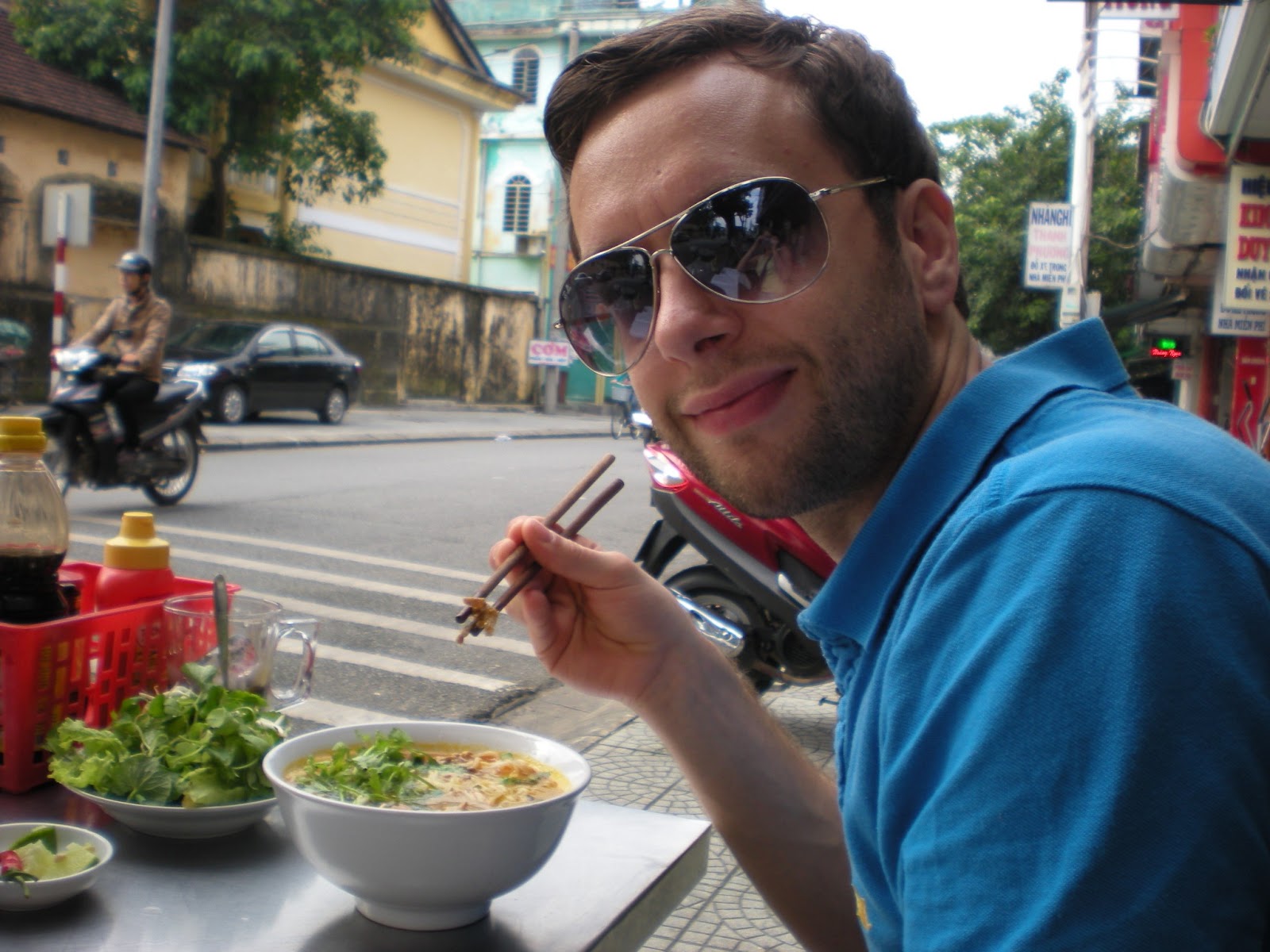
At lunchtime we headed out of the citadel and ate streetfood at a hole-in-the-wall cafe with a welcoming owner. We ate bun bo- a delicate Hue speciality of noodle soup with meat, infused with lemongrass, and minced meat kebabs served with rice paper, green leaves and hot chilli jam to make tasty pancake rolls, and caramelised fish served bubbling in a clay pot. Chris thought he'd died and gone to heaven.
Delicious Hue street food
In the afternoon we followed the trail of the Nguyen emperors from their living quarters to final resting places. Emperors would plan their own tombs during their lifetimes and would often use them as relaxing retreats while they were still alive. There are several tombs to be visited along the road out of Hue but we went to the closest, and supposedly most impressive- that of Tu Duc, the notorious emperor with 104 wives. It is also said to be his fussy eating that gave birth to Hue's wonderful cuisine. His tomb is set in a wooded garden, in the centre of which is a small lake for boating with a man-made island in the middle that attracts rare birds and animals. We were again lucky to find few other visitors at this site, and at dusk it was lovely to walk around the peaceful lake, the temples (one of which was dedicated to Tu Duc's 'minor wives') and the woods.
It was really a whistle-stop tour of Hue but I'm sure we made the best of our day by seeing some beautiful sites and eating delicious Hue streetfood. We spent last night on the overnight train and will soon be arriving in Hanoi.


At Tu Duc's tomb


Saturday, 8 December 2012

The start of our tour of Vietnam

Chris and I arrived in Hue in Central Vietnam this evening by overnight train from Saigon. It was a long journey that passed fairly smoothly besides the upset of spotting a mouse running across the cabin floor in the evening. Chris used his initiative in creating a humane makeshift mousetrap out of objects we had available to us (a plastic bottle, crackers and lip balm), but by the next morning the trap appeared untouched aside for a couple of mice droppings lining the inside of the bottle... Damn. Besides this, and the general grubbiness of the beds and floors, the train was a fine way to travel. We shared  a cabin with a friendly older Vietnamese couple and enjoyed reclining on the beds while watching scenes of rural Vietnam pass slowly by. At lunchtime we bought a hearty meal of rice, green beans, tofu, chicken and soup for little more than a pound each, and at station stops women selling drinks and fruit would board the train.
Between Danang and Hue we followed the coastline, giving some pleasant views despite the heavy white sky. We arrived in Hue and checked into our hotel before going for a walk to the citadel that houses the remains of the imperial capital. We ate at a cheap Japanese restaurant before a drink at a roadside bar. We had already heard that there is not much of a nightlife in Hue- most come here for the history and boat trips down the Perfume River to see the imperial tombs outside of the city. Chris and I only have one day in the town before another overnight train to Hanoi tomorrow.

Riding the Reunification Express from Saigon to Hue

Over the Perfume River in Hue

Checking out war planes inside the citadel

Wednesday, 5 December 2012

Reunited with Chris

I had been looking forward to Monday evening for a long time as my boyfriend Chris arrived in Ho Chi Minh City to spend five weeks with me; I hadn't seen him since I left for Vietnam three months ago. I spent the day pampering myself at the local salon and in the evening took a taxi to the airport feeling full of nerves and anticipation. I waited around for over an hour until I saw him coming through arrivals. I ran over and we had an unexpectedly emotional reunion moment in front of a large audience of bystanders, until the security guard blew his whistle at us to make us move along. It was quite embarrassing but I was, and still am, over the moon to be with him again.

Yesterday I took Chris to the local pool, which we had to ourselves as it was a Tuesday lunchtime, where we relaxed and enjoyed some poolside food and drink. Chris has really taken to Cafe Sua Da, Vietnamese iced coffee mixed with condensed milk- truly delicious. In the afternoon we rode our bikes to a salon, where Chris had a haircut and I had a foot massage, watching him eagerly and to his immense embarrassment. The girl who cut his hair was skinny and boyish with an afro, something which amazed and perplexed me, and took a pair of scissors to his hair without hesitation and without really establishing how he wanted it done. I could see Chris looking uncomfortable but he didn't say anything as she hacked away at his precious fringe and Liam Gallagher-style flicks at the back. However, I think he looks very dapper with his new, 'grown-up' hairstyle. 

Today we had a nice day out at the history museum and zoo, set in a huge garden that is very attractive. A slightly scary experience at the zoo was coming close to witnessing a rabbit being consumed by an enormous python. The unfortunate bunny had one lopsided ear, making it look a little stupid. It certainly lived up to this expectation by hopping right up to the lethargic snake at the other end of the tank, tempting fate. It was horrible but captivating to watch. We were joined by an Australian tourist who took some interest in the inevitable rabbit annihilation. I dragged Chris away before we could see the horrible end.


We will spend a few more days in the city and on Friday will begin our two week trip to Hanoi and back by train, taking in most of Vietnam's major towns and cities. I will be sure to post photos and stories from our travels whenever we have the opportunity along the way.

Saturday, 1 December 2012

An art tour with Sophie


The lovely Sophie at Frontline Gallery
Yesterday Jessica and I took part in Sophie’s Art Tour of Ho Chi Minh City, visiting five of the city’s galleries to explore how the Vietnamese art world has developed and augmented through the recent periods of colonialism, war, independence and globalisation. We met in a café in the city centre in the morning, where we drank and iced coffees and heard an introduction to the tour by our guide, Sophie Hughes. Sophie has worked in the arts in Ho Chi Minh City for three years and began her tour as a way of providing the information about Vietnamese art history that is neglected in the city’s museums. She is a lovely young woman- fun, knowledgeable and friendly.

There were to be four sections of the tour: the colonial period and the development of Vietnamese art under French influence, the two Indochina wars, covering the documentary work of combat artists and propaganda artwork, the pre- and post- reunification period and its effect on the lives and works of artists, and finally, the post-Doi Moi (open door) period and the subsequent development of modern, abstract and commercial Vietnamese art.
 
Sophie began with a background to French presence in Indochina. An effective element of her tour was the use of an iPad to show the group photographs and artwork to accompany her explanations; the images she used were well-chosen to provide context and background. One of such images was a poster for the Exposition Coloniale of 1931 in Paris (right), which Sophie used to demonstrate the influence that l’Indochine had on French culture during this period, from fashion to architecture. The poster is aesthetic but inaccurate as the ‘Indochinese’ man in the image, wearing a conical hat, looks black rather than Asian.

In 1651, the French Jesuit scholar Alexandre de Rhodes introduced a Romanised version of the Vietnamese language to a country with very low literacy rates as the established written language, Nom, which used adapted Chinese characters, was incredibly difficult to learn. In 1860, Romanised Vietnamese was introduced to French-run schools, sparking a boom in literacy rates and the development of the educated, intellectual class. From here onwards, the development of modern Vietnamese thought and a turn away from traditional Confucian ideas can be marked. This was significant for the development of the arts and politics.

A portrait of Duc Minh
The first gallery we visited was the Duc Minh Gallery on Duong Le Quy Don. This is a commercial gallery with a private collection that belonged to Mr Duc Minh, an art collector who managed to hold on to his 1,000 or so works throughout the communist takeover period. He had offered his collection to the National Museum in Hanoi on his death in 1983, on the condition that the collection be held under his name. The museum refused this request and so his collection remains in Saigon. This private gallery offers a selection of the works. Many of the works in this gallery came from students of the École Supérieure des Beaux Arts de l'Indochine, established in Hanoi in 1925 by Victor Tardieu and Nam Son. The school taught artistic disciplines such linear perspective and anatomy, and introduced oil painting to Vietnam. Surprisingly, it was also this school that introduced lacquer as an art form. Lacquer, made from the dried sap of the Asian sumac tree, has long been used in religious decoration in Vietnam, but it was a French teacher of the art school, Joseph Inguimberty, who first encouraged the use of lacquer for art, which can be adorned with crushed eggshell, mother-of-pearl and gold leaf to create distinctive artwork. It was here that Nguyen Gia Tri, Vietnam’s most celebrated lacquer artist, was trained.

Sophie demonstrated how impressionist depictions of light and movement on water could be seen in a painting of wooden sampans on a river- a distinctly Vietnamese subject, and explained the controversy of To Ngoc Van’s Girl with Lilies (1943) in depicting a beautiful, rosy-cheeked young girl posing beside a large, open flower: provocative, sensual and challenging to perceived ideas about the function of depicting women in artwork.

Girl with Lilies by To Ngoc Van (1943)

In 1945 Ho Chi Minh declared the independence of the Democratic Republic of Vietnam in Ba Dinh square, Hanoi. Many artists followed him in the Viet Minh resistance movement and relocated to the hills in the North-West of Vietnam. Eight years of fighting ensued as the French attempted the regain control of Vietnam following the end of the Second World War. In 1954, the French surrendered after being overwhelmed at the Battle of Dien Bien Phu. In an attempt to prevent all of Vietnam ‘falling’ to communism, the international community decreed at the Geneva Convention to split Vietnam at the 17th parallel of latitude, with a communist, Russian-supported North and a capitalist, US-supported South. The USA installed Catholic and anti-communist Ngo Dinh Diem to preside over South Vietnam through a fraudulent plebiscite in 1955. Diem’s lack of popular support and the widespread corruption within the South Vietnamese government led to the state digressing into a military one. American troops were sent to monitor the situation and to aid the South Vietnamese Army (ARVN) in opposing resistance groups, the roots of the two decade long American War.

Richard compares an original to its reproduction 
We looked at the work produced by combat artists who documented both wars from the frontlines, and the propaganda art that was produced during the period. The two were often interlinked. Firstly, we visited Frontline Gallery in the home of Richard di San Marzano and his wife. Richard is the curator of the Dogma Collection, the world’s largest collection of propaganda posters. We visited the Dogma Gallery and Shop later in the day. The artworks in Frontline gallery were mostly reproductions of canvas and paper paintings and sketches produced by combat artists. Sophie explained that as 60% of combat artists were killed in the battlefields, those who survived were reluctant to let go of pieces of art that were very meaningful to them, testaments to the experiences they lived through. Reproductions were seen as a solution to this difficulty- allowing artists to keep their original artwork while displaying copies for the public to appreciate. Many of the artists on the frontline met former students of the French art school in Hanoi, some of whom would set up workshops or exhibitions in the jungle. In this way, French art lessons were passed between young Vietnamese artists in the midst of the resistance fight against the French, Sophie neatly observed. She pointed to a sketch of a group of soldiers by Nguyen Duc Tho that uses a composition technique typical of the Italian Renaissance, whereby the composition is formed in a spiral shape to draw the eye to the centre of the image, replicating natural forms such as shells, flowers and fossils.

The images in Richard’s gallery weren’t masterpieces- most were produced very quickly due to the dangerous environment- but they were very interesting and important historical documents of the lives of soldiers and civilians at the forefront of the war. Huynh Phuong Dong’s Decorated Hero, Nguyen Van Dung (1963) (right) shows the bravery of both the subject and artist in facing oncoming South Vietnamese tanks and US helicopters in a battle. Another value of the work of combat artists was the therapeutic effect on soldiers of sitting for portraits. In the dehumanising environment of war, soldiers greatly valued this care and attention and would treasure the images produced by the artist. Indeed, artists were highly valued within the military. It was interesting to note that several of the works on display featured children; Sophie reminded us that the war permeated everyday life for much of the Vietnamese population. Civilians were often armed and would occasionally shoot down US planes!

We went on to the Dogma Gallery and Shop at 43 Ton That Thiep, where we saw a sample of propaganda posters produced during the war and afterwards, in the rebuilding of the reunified nation. In fact, socialist realist-style propaganda remains the preferred method of public communication by the People’s Committee, as can be seen by looking at government posters across Ho Chi Minh City. Sophie explained that Vietnamese propaganda art is unique from Chinese and Russian counterparts as the images are individualised, the wording is poetic and works are often signed. They were often naive in style as they were produced by untrained artists. Many feature distinctive iconography such as the lotus, the national flower, and images of ethnic minority people, who helped liberation soldiers from the lowlands by showing them how to find water and avoid disease in the jungle highlands. It is also worth visiting the great little souvenir shop on the ground floor which sells mugs, magnets and notebooks based on propaganda images.

'The most beautiful flower is the lotus; the finest name is Uncle Ho'- from the Dogma collection online 

At the Fine Arts Museum we compared artworks of the pre- and post-reunification periods and saw work from Southern artists for the first time. In the wartime period art flourished in Saigon, where there was relative peace and the fashion and rock n’ roll culture of the swinging sixties took hold. Sophie showed us around some of the work and pointed out how European art had influenced the work of Vietnamese artists, albeit with a significant time lapse. When the North Vietnamese Army and National Liberation Front forces captured Saigon in April 1975 and reunified the north and south under a communist government, many artists fled the country and abandoned their work to escape persecution. Therefore the collection at the Fine Arts Museum is rare and valuable.

The new communist government, primarily made up of Northerners, appreciated the importance of artists but were careful to rigidly refocus and regulate their work. Artists were sent to ports, railway lines and factories to document the reconstruction of country in a celebratory nature (although the government ceased to send artists to ports when so many of them went missing). They would also be subjected to eight-hour lectures on Marxism and Vietnamese culture by Ho Chi Minh’s right-hand man, Trung Chin. Art was stifled into uniform, socialist realist propaganda pieces. In 1975, a Northerner named Nguyen Kao Thuong became the headmaster of the Saigon Fine Arts University. He set about destroying all nude sculptures in the buildings and redirected the school to only produce government-approved artwork.

Where the Vietnamese art scene came into its own was following the Doi Moi, or open doors policy, of 1986, when the government opened up enterprise and foreign investment to the country in order to kick-start its shattered economy. Foreigners and returning Vietnamese informed the new art scene; investment allowed artists to experiment with expensive mediums such as sculpture. The two prevailing streams at the time were that of abstract art as an expression of the excitement of new-found freedom, and a nostalgic return to the romanticised imagery of the ‘old Indochina’. In 1990, the first commercial gallery was opened on Dong Khoi and many more followed. Unfortunately, many of these were exploitative of artists who were desperate to make some money for the first time in decades. With this boom, artists, previously a highly respected but impoverished class, could become incredibly rich by producing commercial, popularised art. Sophie gave us the example of a hugely popular Saigon-based artist named Nguyen Thanh Binh. He began producing very beautiful and simple paintings of Vietnamese girls wearing white ao-dais carrying lotuses or ballet-dancing, which have become incredibly popular in Vietnam. On a trip to the UK, he was taken to Cambridge and was so besotted with the town that he vowed his children would study at Cambridge University. Returning to Vietnam, he continued to produce artwork following the popular trend, often very repetitively, in order to fund his dream. Sure enough, both of his children went to British universities (although Newcastle and Hull, not quite Cambridge) and Binh was satisfied. When asked about his work, however, he feels that he is merely producing a popular product, not art.
One of Nguyen Thanh Binh's works

Me outside San Art
In the final chapter of our story, we visited San Art, an artist-run exhibition space and reading room in Binh Thanh district since 2007. Such places are very important to the Vietnamese art scene in filling the gap left in the rigid teaching of art in state education. Apparently, foreign teachers in Vietnamese government schools are not permitted to teach art theory or critique to students, only the technical aspects. It takes independent galleries and projects such as this one to provide the diverse study and access to information that young Vietnamese artists may miss out on. San Art recently hosted Vietnam’s first artist-in-residence project over a six-month period, the results of which we went to see.

I learned from this tour that there is more to Vietnamese art than the approved socialist realist pieces of the Fine Arts Museum and the replicas of Van Goch and Klimpt in the Dong Khoi commercial galleries. Hidden in residential streets behind wrought-iron gates are private collections that mark the most interesting cultural moments of 20th and 21st century Vietnamese history. Sophie’s tour was successful in putting the pieces together of a dramatically changing art history. But at 950,000 dong (almost £30) a pop, it is very dear. With the Fine Arts Museum providing very little information for visitors, and considering the lack of government funding for the and the censored education system, it seems that, sadly, for a real art education, students, tourists and Vietnamese alike must turn to the private sector.